Jan 13, 2026
For decades, museum professionals have focused on the physical threshold—the architecture of the foyer, the warmth of the welcome desk, the clarity of wayfinding. We treat the museum visit as something that begins the moment the visitor steps through our doors.
But in an increasingly digital-first world, that threshold has moved.
For a significant portion of our potential audience—particularly Gen Z and digital natives—the journey to the museum begins on a screen, often weeks before they set foot in the city. The decision to visit is formed in a digital "pre-visit" phase where they silently ask three critical questions:
Does this place feel relevant to me?
Do I understand what the experience actually is?
Is it worth my limited time?
There has long been a fear in our sector that offering high-quality digital experiences might discourage physical attendance, that if we give the "milk" away for free, no one will buy the cow. However, recent data suggests the opposite is true. A well-crafted virtual "teaser" doesn't replace the visit; it actually increases the visit intent of its users - making it a relevant tool for museum marketing.
Moving Website visitors from "Maybe" to "Must-See"
A recent survey conducted by Atopia offers a compelling counter-narrative to the sticky argument that virtual tours make people "not want to come anymore": 73 European participants, recruited via advertisements to represent a broader potential audience, were asked: If you only had two days in New York City, would you visit The Met?
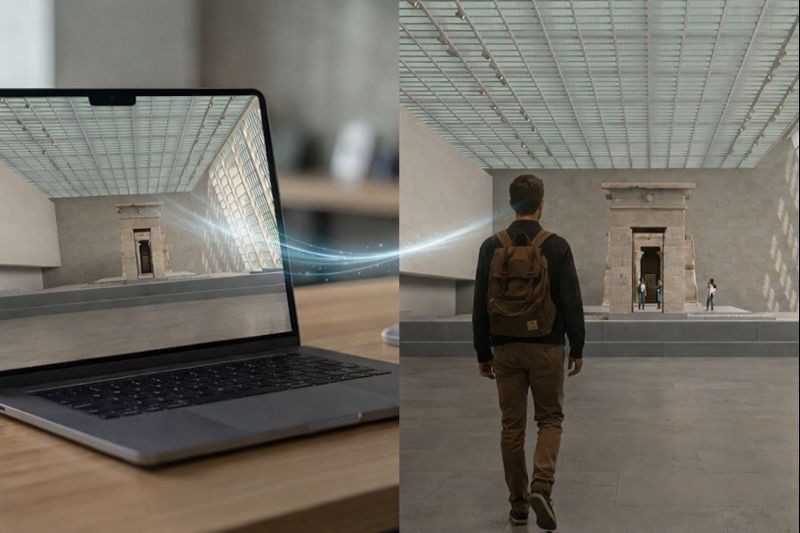
The participants were asked this before and after exploring The Met’s “Dendur Decoded” virtual experience (Web version) the museum recently co-created with Atopia, which lets you interactively explore the famous temple first in a digital twin, later in different historic environments from the original Nile location, and finally within the wing currently under construction inside Central Park.
The results were significant. After engaging with the virtual experience, there was a 22% increase in participants answering "Yes" compared to their baseline. The digital experience didn't satisfy their curiosity, but rather sharpened it.
Why the "Teaser" Model Works
Why does a virtual preview drive such a significant increase in intent to visit? At Atopia, we believe it comes down to two main reasons:
1. Replacing Uncertainty with Confidence
Museums can be intimidating spaces. For non-traditional visitors, there is often a "threshold fear" - a worry that they won't understand the art, or that the space isn't "for them." A static website with opening hours, artwork close-ups and ticket prices seldomly succeeds in assuaging this.
A virtual teaser allows these people to "sense" what it's like to spend time the space before committing. It serves as a low-risk trial, replacing the anxiety of the unknown with the comfort of familiarity. They will be more confident to buy a ticket when they feel like your museum will be interesting and relevant to them. When they finally walk through your doors, they already feel like they belong.
2. Building a Connection with the "Hero Object"
Text on a webpage is informative, but it is rarely emotional. A virtual experience allows a user to build a connection with a central narrative or a specific object. By letting a user build a connection with specific artifacts from your collection digitally, we create a parasocial relationship with that object. The digital model does not replace the original, but rather creates a longing to see the real one in person. This is similar to why so many people still queue to see the real Mona Lisa despite already knowing what it looks like from images, and likely being able to see the details much better on a scan.
Conclusion: Visibility is Validity
To succeed in a digital-first era, museums need to stop viewing digital and physical as competing entities. In the current attention economy, a virtual 3D teaser can be the deciding factor in a visitor's itinerary.
By offering a preview that highlights the relevance of your themes and the beauty of your spaces, you aren't "giving the experience away." You are providing the necessary bridge for a hesitant public to move from "I’ve heard of this museum" to "I want to go there."
If you're interested in exploring how museums like The Met leverage this medium through Atopia, check out our case studies: https://atopia.space